Make Me Beg
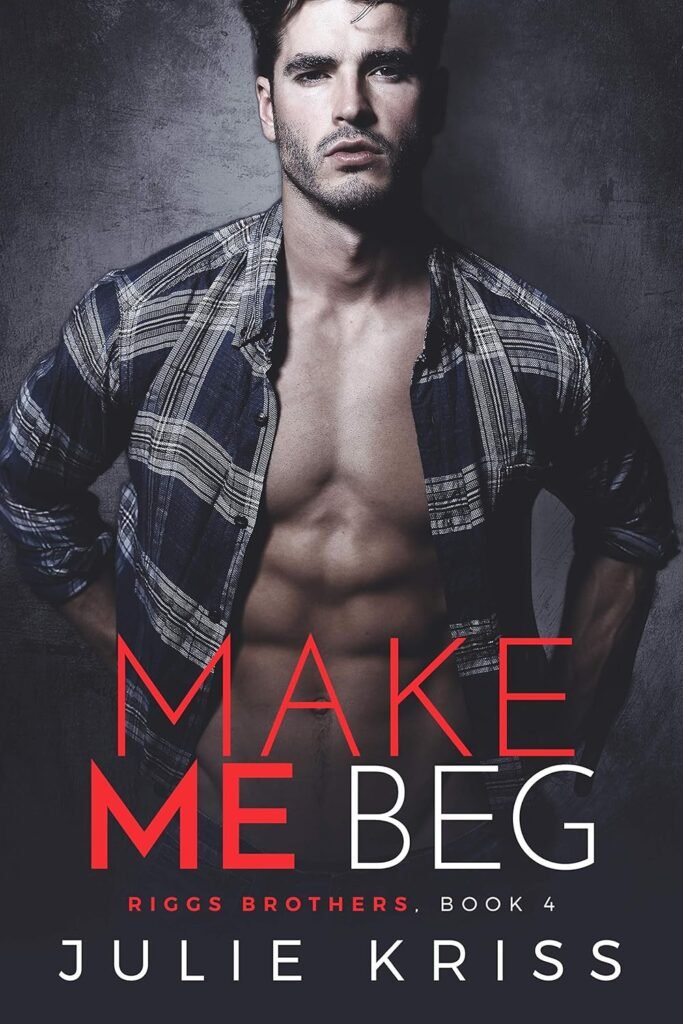
The last of the Riggs Brothers books lands as smoothly as Dex Riggs himself—reckless, a little messy, but somehow still on its feet. I’d been curious about Dex—sure that, like his brother Jace, he was a good guy with a complicated past. But unlike Jace, whose backstory was tedious and nonsensical, Dex’s is gripping, and its resolution satisfying.
Dex was always the wild one. In a family of four feral boys from the wrong side of the tracks, that was saying something. He was the most likely to land in jail, the most likely to drink too much, the most likely to self-destruct—so of course, he shocked everyone by becoming a cop. And then he shocked no one when he lost that job under a cloud of suspicion and slunk back home, bruised ego in tow. No one expected much from Dex Riggs. Except Lauren.
Lauren, sister of Emily, is freshly divorced from her asshat ex—do they always have to be asshats?—and laser-focused on having a baby. So when Dex, for whom she’s always secretly lusted, halfheartedly hits on her, she flips the script and makes him an offer: a no-strings-attached kid.
Let’s pause here. The no-strings baby trope is always a stretch, but in a town where secrets last about as long as a sneeze? Practically science fiction. But here, I was willing—mostly—to roll with it.
As in every Kriss book I’ve read—this is #5—once Lauren and Dex start setting the sheets on fire (and Kriss writes a damn good love scene), emotions follow. On the surface, they’re opposites, but at their core, they’re both restless, both exhausted, both longing to be truly seen and chosen. Their connection works. Mostly.
The suspense plot—unconnected to earlier books—is solid, and I liked its resolution. In the first three books, we’ve seen Dex struggle with substance abuse, and, like his brother Ryan’s, it clears up remarkably fast once the right woman enters the picture. We’ve also seen him be a jerk to just about everyone, though Kriss gives him enough backstory to make his behavior understandable. More or less, I bought both his past and his transformation. But here’s where Kriss frustrates me—because buried within all this is the kind of writing that suggests she’s capable of so much more.
Kriss is a hero-centric writer, meaning her books hinge on the hero’s appeal and journey more so than on the heroine’s. The result? The men feel fully realized, while the women often orbit around them. Lauren, for example, admits she has no real friendships, no hobbies, no passions outside of wanting a baby. And while the series ends with all four Riggs women forming a strong bond, it’s frustrating that it takes pairing off with a man for each of them to find meaning.
What’s most frustrating is that Kriss is a better writer than this book, and the others in this series, suggest. Threaded through this novel are moments of startling clarity—sharp observations on social prejudice, gender roles, and the flawed human condition—that hint at something richer beneath the surface. She has the skill to write gorgeous sentences, to slip in insights that make a reader pause. But she doesn’t do it enough. Instead, those moments are scattered, almost accidental, buried beneath the efficiency of a well-paced, easily devoured romance. This book delivers exactly what it should—but it could have been something more memorable. Maybe next time.