
Promise Me Sunshine
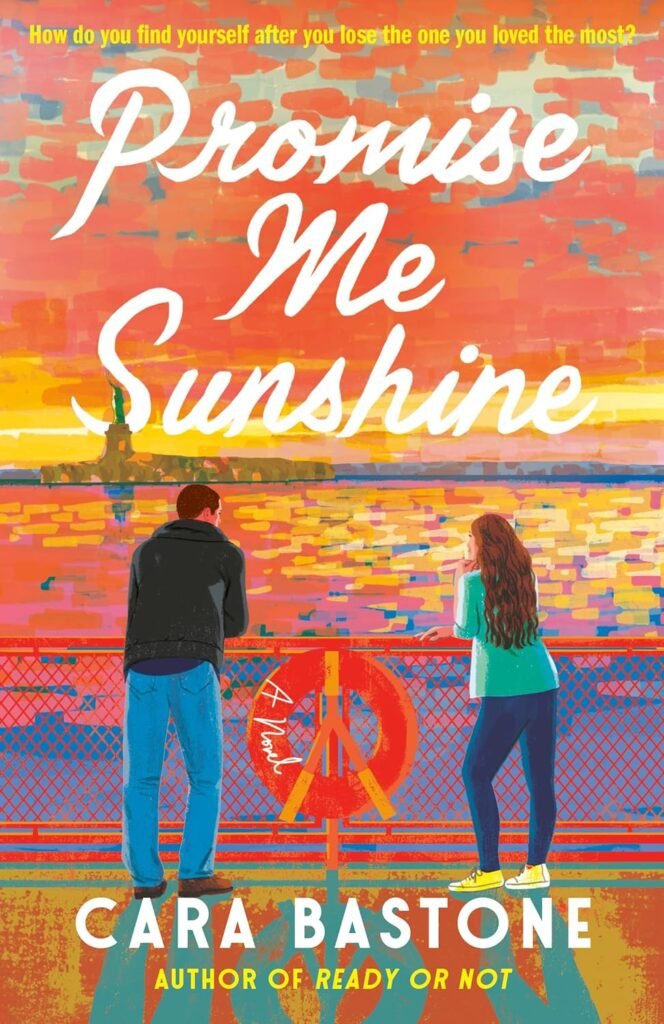
I wasn’t in the mood for a grief novel. Lately, real life has been more than generous on that front. A story about a woman paralyzed by the loss of her best friend sounded like more emotional weight than I needed to carry.
But Promise Me Sunshine surprised me.
Yes, this is a novel soaked in sadness. It’s also full of humor, charm, and quiet acts of courage. Cara Bastone doesn’t glorify grief or hand it a redemption arc. She tells the truth: living with loss is hard, and doing it anyway is a kind of triumph.
Lenny is barely functioning. Her best friend Lou—more soulmate than sidekick—is gone, and she’s floating through days with no direction and less hope. A babysitting job brings her into the orbit of Miles, her employer’s brother, who’s also grieving in a different, quieter register. They strike a deal: Lenny helps him connect with his niece, and he helps her work through the “live again” list Lou left behind. It’s an emotional scavenger hunt—equal parts therapy and dare—and it’s exactly the structure this novel needs.
Their connection builds slowly. Way too slowly, if I’m honest. They’re drawn to each other with a steady, unmistakable pull, and while it’s lovely to see friendship come first, the pacing starts to feel cautious rather than earned. This slow slow burn is especially irksome given that it’s obvious from the moment Miles and Lenny meet that they vibe big time. Honestly, I just didn’t buy that sex wouldn’t have, ah, reared its head much earlier in their relationship.
Still, the romance does work. Miles and Lenny have a lovely way with each other–this is the rare romance that I’m not sure I’d have minded if they just stayed friends. We all deserve a friend like Miles. He’s perfect in every way–utterly unbelievable but, hey, this is aspirational fiction and if you can’t find a perfect man in a romance novel, where can you?
Miles’ perfection does make Lenny seem a lot. Her behavior is routinely so whacky that I just didn’t buy it. The way she is and talks is great fun to read about but no one would see it as real. The exception to that is, again, her grief. Her best moments are her rawest–her sense of overwhelming loss is so powerfully written that, more than once, I teared up as she lost it over losing Lou. When the writing lets Lenny be raw instead of whimsical, she is a much more powerful character.
Ainsley—Miles’s seven-year-old niece and the child Lenny babysits—adds welcome texture. She’s not a plot device or a precocious sidekick. She’s a real kid: joyful, unpredictable, needy, full of opinions and affection. She adores Lenny and Miles, and the scenes with all three of them crackle with warmth. But Bastone threads in something quieter, too: Ainsley sometimes misses her mom, Reese, whose job keeps her away more than either of them would like. The book doesn’t turn this into melodrama, but it allows the truth to breathe. Even in loving, well-supported families, absence leaves a mark—and the novel earns points for acknowledging that without apology or fix-it energy.
Most of the other supporting characters are great fun–I really loved the friends Miles forces Lenny to make, especially the terrifyingly glamorous Rica and the impossible to resist Jericho. I was less enamoured of Lenny’s parents or, more specifically, the way that Lenny has treated them since Lou died. I’m sorry, I get she’s lost the love of her life. But that doesn’t mean you ignore those who love you and who loved the one you lost. Were I Lenny’s mom, I think it would take me more than a moment to get over Lenny’s behavior.
So, I liked but didn’t love the romance here. Again, this is really a story about coming to terms with death. And here, Bastone doesn’t flinch. There’s no grand takeaway here, no syrupy lesson. Just this: love costs something—sometimes everything—but the alternative is a life half-lived.
Promise Me Sunshine understands that the risk of being known, really known, is terrifying, especially when you’ve lost before. But it also shows how electric it can be when someone sees your grief, your chaos, your softness—and chooses you anyway. This novel doesn’t promise healing. It promises connection. And in the face of loss, that might be the most powerful thing we get.