
Shadow and Tide
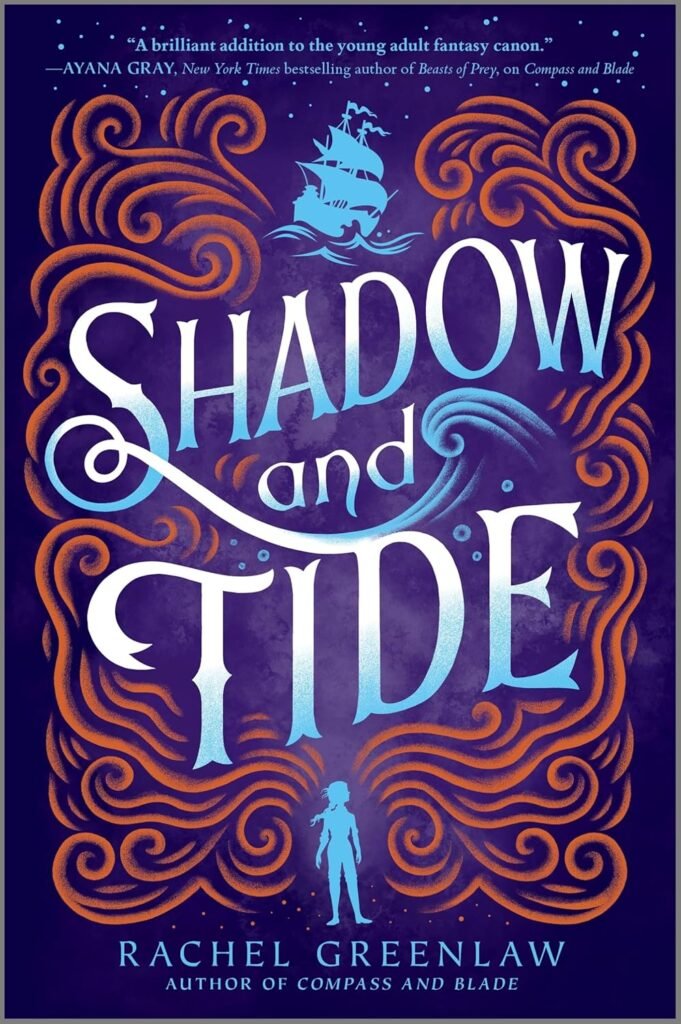
Rachel Greenlaw’s Shadow and Tide, the second book in her Compass and Blade trilogy, doesn’t lose its way, but it does drift. It expands the world, raises the stakes, and complicates its characters, yet in its effort to do more, it sometimes loses the tight, gripping focus that made Compass and Blade so compelling. The story is always in motion, but not always with direction, and while it charts an intriguing course for the finale, it occasionally gets caught in its own currents.
When the watch strike, burning her home to the ground, Mira teams up with Elijah, calling in her bargain to uncover the truth about her abilities and destroy Captain Renshaw and the watch. To do so, she’ll need help—from her friends and from the witches. Meanwhile, at Coven Septern, Hunter Brielle is tasked with an unusual mission: to track down a human girl. The Coven has never hunted humans before. The assignment feels wrong, but refusing orders isn’t just rebellion—it’s an identity crisis. Brielle was made to be a Hunter. If she questions her purpose, does she unravel herself in the process?
Brielle’s conflict is the most interesting dilemma in the book. The Coven has always drawn a hard line—non-humans are the enemy, Hunters enforce the law. Now, that certainty is unraveling. The real question isn’t whether Mira is dangerous, but who gets to decide what dangerous means. Greenlaw doesn’t just hint at the politics behind it; she leans in, making it clear that here power about justice but rather control, that the ones in charge define monster however it suits them. It’s a compelling thread, adding depth to the world and tension to the story. But this isn’t Brielle’s book. Shadow and Tide belongs to Mira, and while Brielle’s arc complicates the narrative in intriguing ways, she’s a piece of the larger puzzle, not the whole picture.
Then there’s Eli. We finally get his backstory, which adds some needed depth, and his relationship with Mira continues to develop. The problem? It’s a slow burn that’s barely smoldering. The chemistry is there in theory, but in practice, it feels like a relationship built on meaningful glances and not much else. I don’t need them tearing each other’s clothes off, but I do need to feel something—urgency, tension, desire, anything beyond just quiet admiration. Right now, it’s more like a pleasant courtship in a drawing room than a romance forged in battle.
Pacing-wise, the book moves fast—sometimes too fast. The action sequences pile up like waves in a storm, relentless but not always distinct, while the quieter moments feel more like enforced stops than natural shifts in rhythm. Greenlaw can write tension, but the book needed a steadier hand at the wheel. And, of course, there’s a cliffhanger—because this is romantasy, and that’s the law. Does it make me desperate for book three? No. But am I going to read it? Yes.
Because for all its unevenness, Shadow and Tide still holds the course. It expands the world, sharpens the stakes, and introduces questions that should make for an explosive finale. Book three has a choice: steer this series toward something unforgettable or let it sink into the ordinary. Right now, I’m still on board—but I’m not holding my breath.