
The Christmas Miracle of Jonathan Toomey
(originally published on December 25, 2019)
Despite being a family of non-believers, every year we pull out our holiday paraphernalia. We dress the tree, hanging with care the delicate glass ornaments gifted to us over the many years, sentimentally rub our fingers over the ones our children made, pull out the stepladder and put our angel to balance precariously on the top branch. We play endless Spotify holiday playlists (here’s my favorite) and watch Love, Actually and Elf for the millionth time. And we bring out our beloved holiday books. We giggle over Morris’ Disappearing Bag, admire the wit of Auntie Claus, and wipe away the tears as we marvel over The Christmas Miracle Of Jonathan Toomey.
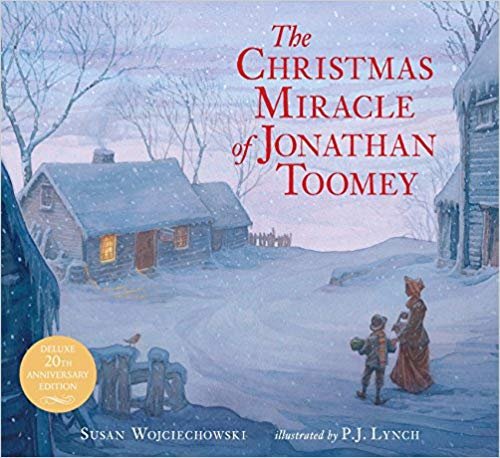
Published first in 1995, Susan Wojciechowski’s profoundly moving tale is many things. It’s a meditation on grief, a testament to learning to live after soul-crushing loss, a paean to power of selfless love, and celebration of the Christ’s story. Not only is the prose pitch perfect but the illustrations are Caldecott worthy. (If your family listens to audiobooks, the narration by James Earl Jones is sublime and, oh happy day, free for all to hear.)
The book introduces us to Jonathan Toomey, a woodcarver in a small town in colonial America. He keeps to himself and the townspeople, who call him Mr. Gloomy, see him as a curmudgeon who complains when the birds sing and the children play.
The village people didn’t know it, but there was a reason for his gloom, a reason for his grumbling, a reason why he walked hunched over, as if carrying a great weight on his shoulders. Some years earlier, when Jonathan Toomey was young and full of life and full of love, his wife and baby had become very ill. And, because those were the days before hospitals and medicines and skilled doctors, his wife and baby had died, three days apart from each other. So Jonathan Toomey had packed his belongings into a wagon and travelled till his tears stopped. He settled into a tiny house at the edge of a village to do his wood-carving.
 One day, in early December, there’s a knock on his door. It’s the Widow McDowell and her seven year old son Thomas. They’re new to the village and have heard that Jonathan is the best wood carver in the area. In their move, they lost a much loved Nativity set and they’d like him to remake it. Despite asserting that there are no miracles and that Christmas is pish-posh, he agrees to do the work.
A week later, the widow and Thomas come to check on Jonathan’s progress–Thomas wants to be a woodcarver and he sits by Jonathan’s side as his mother knits. They are at first silent but then,
Thomas whispered, “Mr Toomey, excuse me, but you’re carving my sheep wrong.” The widow McDowell’s knitting-needles stopped clicking. Jonathan Toomey’s knife stopped carving. Thomas went on. “It’s a beautiful sheep, nice and curly, but my sheep looked happy.” “That’s pish-posh,” said Mr Toomey. “Sheep are sheep. They cannot look happy.” “Mine did,” said Thomas. “They knew they were with the Baby Jesus, so they were happy.”
I won’t spoil the rest of the story except to say that the tale of this Christmas miracle is one that never–never–fails to fill me with joy. It reminds me that there are no greater gifts–or strengths–than faith, hope, and love. To read it is to immerse yourself in their power.
I wish you and yours a holiday season filled with love and joy. Thank you for all your support and insight this year. I look forward to 2020 and another year (it will be our 25th) reading and discussing books with you!
All the best,
Dabney
P.S. This is the first A+ I’ve ever given here at AAR.