The Moonlight Market
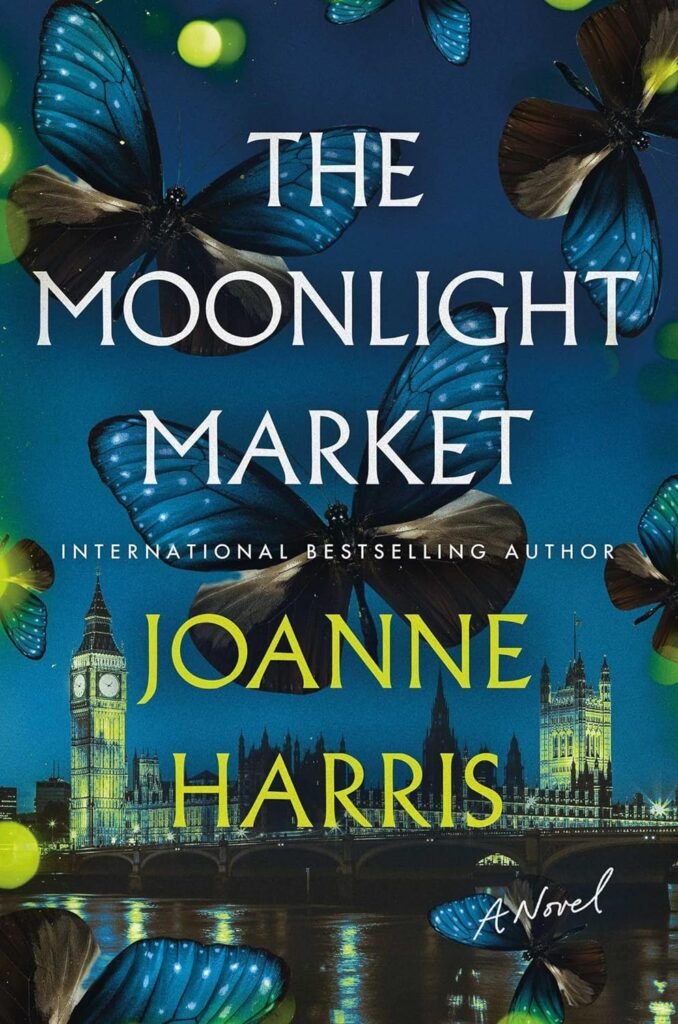
Deep in the heart of London, a young photographer named Tom Argent walks the streets and captures whatever catches his eye: an old man drinking coffee; a striking woman sipping champagne in St. Pancras station; a cloud of moths taking flight across the sky. He’s orphaned, lonely, and lost in his work. He certainly has no intention of falling in love.
And yet, love finds him in the shape of beautiful Vanessa, who lives a dangerous double life in the heart of the city. Tom’s pursuit of Vanessa leads him to discover an alternate world, hiding in plain sight among the streets and rooftops of London. A world unseen by common folk and inhabited by strange and colorful beings, in which two warring factions—one nocturnal, one in the light—wage war for the sake of a long-lost love, which can only end with one side’s total annihilation.
Dabney: I have been a Harris fan for decades. The Moonlight Market utterly enchanting and I adored it. Marian, how did you feel about it?
Marian: It’s certainly different from Chocolat and Five Quarters of the Orange, just as deliciously atmospheric but with more of a fairytale feel to it. It wasn’t a perfect read for me, but it was very close.The gradually revealed story of the war and its consequences was like myth meeting reality, and this book made me want three things : 1. a pair of wings 2. a visit to the Moonlight Market 3. a sequel.
Dabney: SO, in the world of this book, humans exist side by side with fairies. The fairies, due to a romance that turned sour ages ago, have split into two kingdoms, that of the Moths and the Butterflies, and are at war with one another. Tom, a man who lives a quiet, rather empty life as a photographer in London, falls, he thinks, in love with a Butterfly, the gorgeous Vanessa. As he pursues her, he becomes ensnared in the fairy world and its war. And, slowly, he realizes his connection with the fairies runs far deeper than he would have ever expected.
I loved this set up. I love fairy tales and this is an intricate one, with heroes and villains on all sides. What did you think of the world building?
Marian: Detailed and evocative. You can almost smell the incense and gingerbread and dried flowers in the market. Even the way the fairies speak is different. There are daylight names and midnight names, and I like the nickname for Tom – “chrysalis”, something that could produce either a moth or a butterfly.
Dabney: This is, wonderfully, a love story with both a main couple and an usual secondary one. What did you think–no spoilers!–of the romances here?
Marian: Unfortunately I didn’t enjoy the main romance as much as I did the rest of the book. For a large chunk of the story, I was thinking, “Don’t! Don’t do that! Don’t be taken in!” only to sigh in frustration as the character did exactly what they shouldn’t have done. Plus, there’s glamour and temptation, but I felt these worked their spell for so long that the actual romance got a little shortchanged in the process – in the end, there simply wasn’t enough space remaining in the book to convince me of true love. I liked the individual characters. I just wish they’d had more screen time together to develop their relationship.
When I first read the book, I thought the secondary romance could also have used more development, but looking back, I think this was foreshadowed with the recounting of the myth at the start of each part of the book. It tied up some loose ends as well. I wasn’t as emotionally invested in this one because, to be honest, I disliked one of the characters involved and felt more of a redemption arc was needed here.
Dabney: Tom is irksomely clueless for too long. But I felt that was realistic given how the magic worked on him. So I was frustrated but I accepted it.
Harris has always written leads that aren’t necessarily likeable. My favorite of hers is possibly Runemarks–I have a profound weakness for retelling of Norse mythology–and, in that novel, several of the main characters do things that made me crazy. I suspect I am a reader who doesn’t need to like a character as much as I need to believe they are improving.
So, we’ll agree we see the romances differently!
What else struck you?
Marian: I don’t usually mind unlikeable protagonists outside of romance, but I think with this book, the romantic aspect started early enough that I began expecting Tom to be more like a romance hero rather than “irksomely clueless” (great turn of phrase!). And with other flaws, the character and I can still be on the same page, whereas if a character is intensely naive when it comes to the villain, I’m far ahead and waiting for the character to catch up. But as you said, we see the romances differently!
Another plus point was the time travel aspect. I’m fascinated by alternate versions of cities, and I enjoyed London Before/London Beyond. It’s a great example of the way the story unfolds, beginning with Tom’s small, mundane life but expanding into the secrets of the Market and spreading from there to encompass another world and a different time entirely. I like the plotting here as well, and the twist of how the battle started (if that’s not too spoilery).
Dabney: We’re both agreed that the world building alone in this book justifies the read. I loved the Londons and how they overlapped. The Midnight Market is a stand alone which, in terms of this story, is good. There are no cliffhangers. But I so loved this world, I kinda wish for more stories set in it.
Other than Tom’s cluelessness, was there anything else you didn’t love?
Marian: The worldbuilding was an absolute delight. So much so that I’m disappointed there’s no sequel – imagine a story that’s about how the Moths and the Butterflies rebuild their society in their own world, or a return to the Land of the Sightless Folk, or a mystery set in the Market.
But as for anything else I didn’t love, potential spoilers again, towards the end of the book, the revelation of a familial relationship made me raise an eyebrow about the completely different direction this relationship had taken earlier. Can’t say much more than that. I think that’s one reason I felt the happy ending was a bit rushed – there’s a lot to unpack, and I felt that after such a long and bitter war, reconciliation and peace would not come easy. But that would have made the book twice as long and might be a tiresome anti-climax as well. And I did enjoy the ending for the fairytale it is; suspend disbelief and it works just fine. It’s only when I step back and think critically that I start being picky!
Dabney: I think I just surrendered to the spell of the book–it is, after all, a fairy tale! If I have a complaint, it is that I too would have liked just a bit more of the story at the end–we learn the what happened but I wished for more how: What does the world look like in the wake of the resolution.
This, thought, is a small quibble. For me, this book is a DIK. How about for you?
Marian : It wasn’t perfect, but it was a very enjoyable read for me. I’d give it a B+.
Dabney: I’d give it an A-. It’s a lovely, lovely read.