
Written on Your Skin
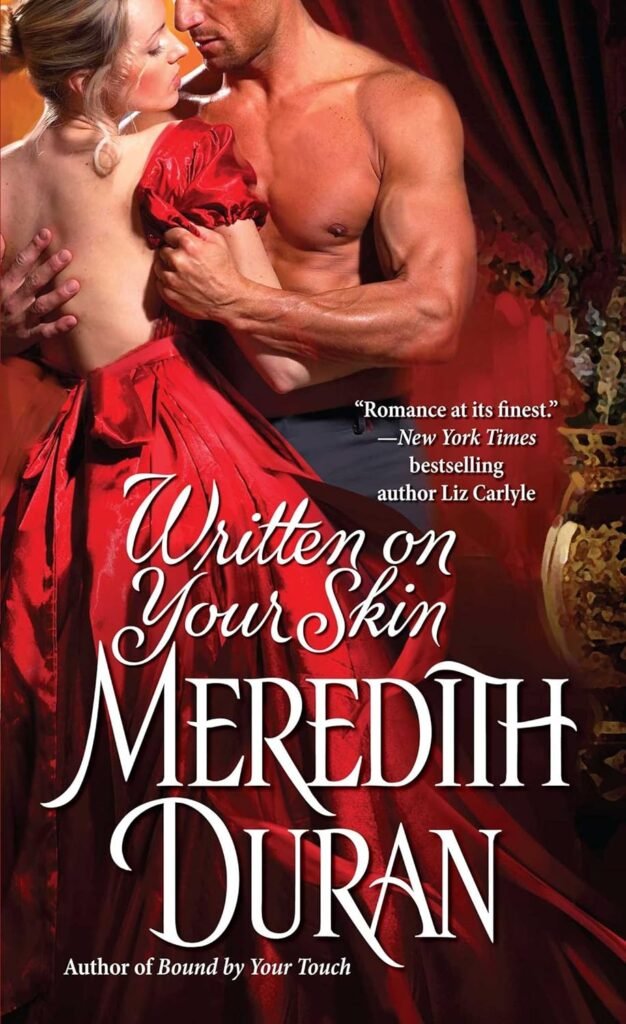
Meredith Duran, whose absence from the world of historical romance feels like a gaping wound in the genre, is one of the finest writers to ever pen a love story. There’s something almost chemical about the way her flawed-but-magnetic characters, lush historical detail, and intricately woven plots come together—they form stories that don’t just entertain; they absorb. Her novels lodge themselves somewhere under your skin, simmering long after you’ve turned the final page.
Written on Your Skin, one of her very best, opens in Hong Kong, 1880, at a party thick with heat and hidden motives. Phineas Granville, a spy embittered by both service and survival, stands at the edge of the room, watching gorgeous and wild American Miss Mina Masters weave her way toward him. Once upon a time, Phin flirted with chatty, vapid Mina, hoping to use her to help dismantle the arms-dealing network of her stepfather, Collins. But, in the end, Phin didn’t need her and now he wants nothing more than to leave Hong Kong behind, Mina included. That plan crumbles the moment Mina follows him into a dark hallway and plants an unwanted kiss on his mouth. Moments after Phin shoves her away, he crashes to the floor, realizing—too late—that the brandy he just drank was poisoned.
Mina, who has mastered the art of being underestimated, recognizes that Phin is not the ordinary spy he pretends to be. As the belladonna courses through his veins, Phin lets slip secrets about Collins—details the businessman he is claiming to be would never know. Despising her stepfather for the brutal way he treats her mother and betting Phin may be able to help her destroy him, Mina makes a split-second decision: she will save Phin’s life, a choice that costs her dearly.
Four years later, Mina, now a successful businesswoman thriving in New York, is in London and terrified. Her mother is missing, and Collins has escaped the prison Phin’s efforts put him in. Alone in a foreign city, Mina has only one person she believes she can trust—the newly minted, reluctantly titled Earl of Ashmore. Phin. He owes her. And Mina intends to collect.
The brilliance of Written on Your Skin lies not just in the hypnotic courtship between its protagonists but also in the historical forces that quietly shape the story’s architecture. By the 1880s, the British Empire was fraying, its control spread thin across colonies like Hong Kong, India, and Egypt. Yet even as it clung to dominance, paranoia infected its policies, particularly in Ireland, where the rising tide of home rule movements and whispered uprisings kept British officials jittery. Espionage became both obsession and necessity, the Crown recruiting agents to sniff out threats before they could bloom. Phin’s transformation from a quiet mapmaker into a government weapon isn’t just backstory—it’s the story of an empire so desperate to maintain power that it corrupts its own citizens, twisting ordinary men into tools of control. Mina’s journey, too, unfolds against the backdrop of imperial hubris. As a woman who has spent her life manipulating a world built for men, Mina understands rebellion better than most. Whether in politics, love, or family, dissent carries consequences. Duran weaves this tension so deftly into the novel that it feels less like a setting than an unspoken force, shifting the stakes of every interaction.
In this context of paranoia and danger, Phin and Mina–this is, after all, a romance–fall in love. But Phin and Mina’s romance isn’t just a love story—it’s an intricate dance between two people who don’t trust anyone, least of all themselves. Phin was drawn into espionage by the promise of mapmaking, and, instead, was manipulated by his handler, an odious man named Ridland, who preyed on Phin’s worst instincts and shaped him into a killer. Inheriting a title finally gave Phin just enough leverage to claw his way out from Ridland’s control, and now Phin’s is determined to oust Ridland from the Service altogether. But freedom that came with his peerage hasn’t really freed Phin–he carries deep scars from his past missions, haunted by PTSD and steeped in self-loathing.
Mina, for her part, has spent her life watching how power confines women, reducing their choices to nothing. She saw her mother trapped under the brutal hand of Collins, and she vowed never to let any man control her. Mina’s weapons of choice are her beauty and charm—men, she’s learned, are easiest to manage when they believe you’re nothing more than a beautiful thing. But Phin is immune to her tricks. He sees through her, and instead of frustrating her, that clarity fascinates her. For the first time, Mina begins to reveal pieces of her real self—not just as a tactic but because Phin’s mind proves irresistible.
The chemistry between Phin and Mina is more than just sparks; it’s alchemy. Their slow-burn romance unfolds like a symphony of longing and restraint, banter and unspoken truths. Duran’s love scenes aren’t rushed—they unfurl in waves of tension and intimacy, exposing not just desire but vulnerability. Many romance writers will tell you that the best love scenes show how two characters feel about each other. Duran goes deeper—her love scenes strip her characters down to their rawest selves, revealing the messy, complicated people they are beneath their masks. In their physical connection, Phin and Mina don’t just find fleeting pleasure—they discover the beginnings of being the selves they never share with the world.
In Duran’s world, love is not a cure-all; it’s deeply worthwhile work. Phin and Mina carry their scars with them, and love doesn’t magically make them disappear. Instead, they earn their happy ending by choosing to try, over and over again, to believe they are worthy of love. Their journey is jagged and uncertain, filled with setbacks and small victories that feel painfully honest. Duran’s portrayal of love isn’t neat—it’s messy, complicated, and real in a way few romances dare to be.
If all that weren’t enough, Written on Your Skin is hewn with stunning prose. Duran writes with an elegance that lingers on the page. Every setting—whether it’s the crowded streets of London or a smoke-filled parlor—feels alive with detail. You can almost smell the lemon oil on the wood, feel the weight of a velvet curtain against your hand, or sense the sky darkening as the clock ticks on. And Duran’s humor—dry, intelligent, perfectly placed—reminds us that even in moments of darkness, there’s always room for wit.
Written on Your Skin isn’t just a novel—it’s an experience, the kind that draws you under and rearranges your expectations of what historical romance can do. For readers who relish the gradual unfolding of a story and characters who defy easy categorization, this book offers a rare satisfaction. It settles in your mind, not as a neatly tied-up memory but as something more elusive—like a shift in atmosphere, a change in light—leaving you momentarily disoriented, as though the world beyond its pages has faded just slightly out of focus. Romance novels simply don’t get any better.